Saturday, May 21, 2011

Fatima: Prayers and Waxy Body Parts!


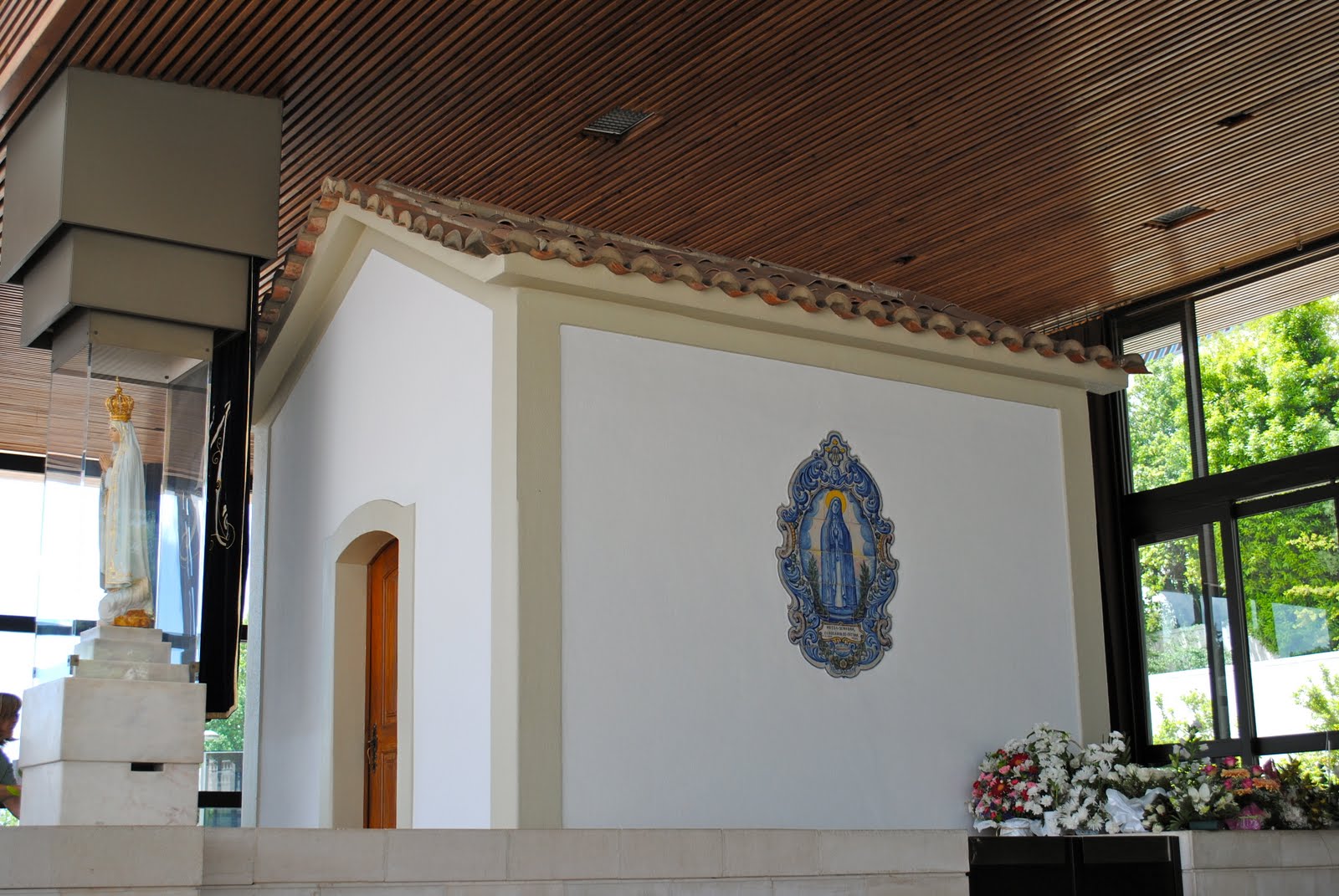
In 1917, three kids encountered visions of Mary near the village of Fátima and were asked to return on the 13th of each month for six months. The final apparition was witnessed by thousands of locals. Ever since, Fátima is on the pilgrimage trail — mobbed on the 13th of each month through the spring and summer.


On my visit, the vast esplanade leading to the basilica and site of the mystical appearance was quiet, as a few solitary pilgrims shuffled on their knees slowly down the long, smooth approach. Staring at a forest of candles and wax body parts dripping into a fiery trench that funnels all the melted wax into a bin to be resurrected as new candles was evocative in this spiritual setting.


Huge letters spelling “Queen of the Holy Rosary of Fátima Pray for Us” in Latin ring the ceiling of the basilica. Pope John Paul II loved Fátima and visited it three times. (After the attempted assassination of JPII, the Vatican revealed that this event was predicted by Our Lady of Fátima in 1917.)


Wandering around modern Fátima and its commercial zone, I’m impressed by how it mirrors my image of a medieval pilgrim gathering place: oodles of picnic benches, endless parking, and desolate toilets for the masses. Just beyond the church, uniform stalls line a horseshoe-shaped mall await pilgrims. Even without much business, old ladies still staff their booths, surrounded by trinkets for pilgrims — including gaudy wax body parts and rosaries that will be blessed after Mass and taken home to remember Our Lady of Fátima.


Here are a few journal entries I wrote while sitting in the church before the statue of “Our Lady of Fatima”:


  • Sitting before the statue on the front pew I put my earphones on and hit random on my iPhone and “Save Me” by Amiee Mann from the movie “Magnolia” plays - Love how random selection works!
  • I just love watching the pilgrims process around the church stopping to pray at the tombs of the young shepherds who reported seeing visions of Mary.
  • I giggle as I observe people posing for pictures in front of Mary’s statue. Some pose with big grins on their faces while others who are waiting to take their picture begin to fix their hair and put on makeup. As they approach the statue they stand for their portrait with one leg kicked back, puffed lips, and seductive pose - Glamor shots with Our Lady. The only thing missing is a boa!
  • The white flowers around the church reminds me that it is still Easter Season and that brings me a joyous feeling.


Later that night I did not rest well. I had many thoughts and dreams resulting from my experiences in Rome and Fatima. I guess it was an evening of reflection about God’s role in the Church and in the lives of its people.


I realized that it the whole scheme of things it did not matter if St Peter’s bones or grave were under the main altar of St Peter’s in Rome or if the visions of the three young people at Fatima were part of their imagination or real: What I do know is that people come to these places in prayer and in their love of God. No matter why people come to the sites or what the theology of the people are God is present. I felt the presence of Christ probably due to the many decades or thousands of years of constant prayer and devotion to God that have been offered in these holy sites. The place is changed due to the devotion and love of God’s beloved NOT because of where someone is buried or where some young children supposedly saw visions.

Wednesday, May 18, 2011

The Necropolis of the Vatican


I was in Rome for a mere two nights after the visit to Assisi. At the top of my list was to visit a special part of the Vatican most tourists don’t get to see – the Scavi. This was my second time to visit the underworld of St Peter’s.

The Vatican Necropolis, or Scavi, is located directly beneath the immense St. Peter’s Basilica and contains everything from the Papal tombs to Roman cities of the dead. I first heard of the Scavi from a friend who visited Rome and knew right away that I had to find a way to visit. The second visit was even more inspiring due to the wonderful tour guide, who was not an employee of the Vatican but rather a contract worker.

The Vatican being the Vatican of course, did not make organizing the visit an easy process. Akin to what requesting anything from a Soviet-era bureaucrat must have been like, the Vatican has set up a very strict protocol that must be followed to the letter.

In order to participate in a Scavi Tour you must:

  • Contact the Excavations Office directly via email. ONLY the actual people going on the tour are to request a tour.
  • You must give the names of participants, language desired, range of dates, etc.
  • At some point prior to your visit, the Office will contact you letting you know whether or not you made it. If you made it, you will be given the exact time and date of the tour and you must pay for the 12 Euros immediately.
  • They have to see each person to make sure you are dressed properly: Women and men no shorts or sleeveless shirts.


Only 250 visitors a day are allowed to participate.

Regardless of the odd ticket procurement process, participation is an absolute must for any visitor to the Vatican.

The guide led us into the basement of the Basilica and opened one of the doors that said “No Public Access.“ Cool. We walked down a staircase, past an oddly modern electronic glass sliding door and suddenly we were there. In the Vatican Necropolis. It was one of those travel moments that at the time you realize just how privileged you are to be in that particular place at that particular time.

For some reason at both underground sites we visited today (other being St Clemente Church) I became very light headed and felt like I was going to faint- Maybe nerves, maybe hungry, maybe overwhelmed.

The entire tour was an hour and a half, but it seemed like ten minutes. We wandered through all of the various levels of excavation, navigated uneven ground previously trod upon by Roman nobles. Included in the tour is an entire Roman city street and necropolis complex. It was incredible to peer through doorways and imagine the city two thousand years earlier.

Finally, our stroll in the musty, humid, wet scavi, walking past long defunct fountains and buildings, ended at what the Vatican believes to be the tomb of St. Peter. The discovery of the Saint’s remains was an effort by an earlier Pope to be buried as close to the Father of the Church as possible. The tour guide gives the group a few moments of reflection before formally ending the tour.

After the tour, you emerge from the darkness into the middle of the Papal tombs and throngs of tourists. The effect is a little discombobulating at first, but in reflection is the perfect end point for the remarkable tour.

The archeological wonders and veritable time capsule that is the Scavi is well worth the time and effort needed to visit this often over-looked area of the Vatican. Thumbs up!


Tuesday, May 17, 2011

The Capuchin Crypt: Human Bones As Far As the Eye Can See


Beneath the Santa Maria della Concezione dei Cappuccini, is the Caphucin Crypt. The real remains of 4000 monks and some children are stacked and decorated in a fashion for reasons that are still vague to this day. I still don't really understand why its there, but its like a train wreck- you just have to look! I was glad that it wasn't actually underground- you just kind of go in at street level and the church is built up on blocks like so many are in Europe which is why its under the church- but there are like 6 separate rooms of bones- I guess I had read they were artistically placed but didn't expect the skeletons to be all pulled apart and arranged in patterns on the wall and ceilings! I mean there's even a skeleton chandellier!! "We are what you soon will be!" is a little sign in multiple languages which can haunt any pilgrim. All I can say is you have to do this. It's Surreal, Strange, yet weirdly beautiful and spiritual too. See it for yourself rather than give too much away. Do make the effort to go up the steps into the church. If you are offered a lightening personal tour by the caretaker TAKE IT,WOW WHAT A TREAT. It's well worth the 'thank you'. You will leave delighted and uplifted in a serendipidy sort of way. You will just have one of those special moments that you really never can plan.


Connecting with St. Francis and Angels at the Portiuncula


The Portiuncula is one of the rare Holy Places in the world and you can feel its energy as one approaches it. The Portiuncula is where St. Francis founded the Franciscan Order of the Friars Minor in 1209.

This is the place where Francis knew first hand the experience of being sustained by the Angels. Likewise, his intimate devotion to Blessed Mary, under whose protection he placed himself to do God's work, did this place become holy for the members of the Franciscan family and for the Church universal. As a place of pilgrimage, the holy Portiuncula is a poignant reminder of how important the encounter with Christ was for Saint Francis and how much the encounter ought to be pivotal for us today. Without meeting Christ, little makes sense. Saint Bonaventure had this to say about this devotion:

The Portiuncula was an old church dedicated to the Virgin Mother of God which was abandoned. Francis had great devotion to the Queen of the World and when he saw that the church was deserted, he began to live there constantly in order to repair it. He heard that the Angels often visited it, so that it was called Saint Mary of the Angels, and he decided to stay there permanently out of reverence for the angels and love for the Mother of Christ. This is also the place where St Clare took her vows and where Saint Francis died.

Before entering this holy shrine inside the larger church I sat in prayer. During my reflection, the song “Peace Before Me” began to circulate in my head. I cherished this private moment before entering the tiny chapel, embracing the feeling of peace which permeates Assisi. The chapel was filled with 12-15 people as a Franciscan monk offered a special blessing over a young boy. Then we all started to pray--I could tell everyone was saying the Lord’s Prayer and the Hail Mary. I was able to join in the prayers not knowing that this was a way to receive the special indulgence offered in this chapel. I then prayed as I walked counter clockwise touching the stones of the chapel. I could feel the centuries of prayers being offered here and a clear sense of peace and comfort fell over me. The angels, many who are from my family, were there to lead me in this holy walk. I kissed the stone church and departed feeling touched by the Holy. I have not yet visited the replica of the chapel in San Francisco but I will visit it often when I return home to remind me of my encounter of the communion of saints.

Peace before us,
peace behind us,
peace under our feet

Peace within us,
peace over us,
let all around us be peace.


Saturday, May 14, 2011

Pilgrimage Dress Rehearsals


Hail, inexhaustible treasurer of life!
- Akathist hymn to Mary

Seeing land again after seven days at sea was a welcome sight. I’ve decided to use these initial ports of call in The Azores, Spain, France, and Italy as “dress rehearsal” sites for the next parts of my pilgrimage. I’ve experimented over the past few days with dry runs to sacred sites in each port, and here are some initial observations.

  • Slowing down and resting for the official start of the pilgrimage in Assisi while making these dry runs has been very helpful. Had I just left San Francisco, hopped on a plane, and began in Assisi, this pilgrimage would be disastrous. The Art of Pilgrimage: The Seeker’s Guide to Making Travel Sacred by Phil Cousineau (Conari Press, 1998) has offered a helpful perspective in this regard. Anyone can read this book and use it for pilgrimages afar and locally.

  • I’m starting to understand the difference between being a tourist and a pilgrim. I have a new vision of travel, observing the ordinary in each place rather than the hot spots or the must-see sites. If travel well done is about seeing things anew, then a pilgrimage is about connecting with the life and spirit of a place anew, looking for the new thing God is doing in a place. As I’ve wandered the open-air marketplaces of Barcelona and Provence in the last two days, I’ve noticed that amidst he hubbub of the bartering and shuffling is a sacredness of life, of interchanges, of people about their daily work. My travel suddenly feels all grown up...I’m losing the childish ways of wanting to visit somewhere to collect a sighting. Instead, as an adult, I want to experience a place.

  • The “Holy” is often not in the place where the long line is. I have experienced the sacred, liminal spaces so far in side chapels, in written prayer requests left by other pilgrims, in the quiet nooks and crannies of vestibules, and, yes, even outside of the four sacred walls. Why is it we so often look for the Holy in assigned spots?!?

  • Because this pilgrimage is such an intimate experience, I need alone time in these sacred spaces. Being rushed, with a traveling companion or, even worse, with a tour group, doesn’t work well.

  • Something I’m realizing is that I’m particularly being drawn to Mary, the Theotokos, the God Bearer, on this journey. Her images are everywhere--on the sides of houses, at high altars, on facades of buildings. Perhaps she is a part of that company of saints speaking to me?

  • At each sacred place I’m visiting, lighting a candle and saying one particular intercession for a loved one in need, and then taking a picture of that candle along with an image of Mary, is helping me to focus my prayer time. I plan to send the image to the person I’ve prayed for. As well, these images help me have a “trail of prayers” to help me trace my journey.

  • I’m taking less pictures than I thought I would. Each day, I’m keeping two or three images that I’m setting aside that will be my sacred images that I will hold dear.

Inspired by a fifth-century conversation between Zi Zhang and Confucius in the Analects, here are five excellent practices for those of us who travel on sacred journeys:

Practice the arts of attention and listening.
Practice renewing yourself each day.
Practice meandering toward the center of every place.
Practice the ritual of reading sacred texts.
Practice gratitude and praise-singing.

Friday, May 6, 2011

Vision and All Saints


Day Three--Thursday, May 5


All sacred journeys are best marked by ritual ceremony. Before leaving the people of St. Aidan’s, all three worshipping communities in the parish surrounded me, anointed me, laid hands on me, and offered prayers for me for the journey and for my time away from them.


The cruise is the first part of my journey, fourteen days of Sabbath, where I am slowing down, resting, catching up, preparing myself to encounter the Holy. In Assisi, I will begin the next stage of my journey, where I hope to treat everything that comes my way as an essential and (perhaps providential?) pieces of the Sacred that God has prepared for me.


This is a wonderful start, but I still need to figure out what the broader theme of my journey will be, how all the pieces fit together, and where and how I will formally start my pilgrimage in Europe. I will begin my journey in Assisi, the first stop after I depart the ship on May 16. I recently rediscovered St. Francis, the Patron of the city where I live, during our Community of Travelers worship service at St Aidan’s. Pastor Megan sang a version of the “Prayer of St. Francis” which helped me realize anew that the Christian life is very simple, but very hard. In Assisi, before the cross where Francis had a vision of Christ asking him to “rebuild my church”, will ask a Franciscan to offer me a blessing.


In my rest and renewal so far, a very clear vision has come to me, which I hope is the beginning thread of a larger theme for my journey:


In my mind’s eye, I see a “U” shaped stage, and at the front of the stage is a very thin vertical curtain. The curtain is slightly parted, with an old timey microphone at the center of the stage. Behind the curtain are many, many people who are all trying to stick their heads out to sing. It is an exciting atmosphere, with dramatic colors of blue and grey cloaking the frenetic energy of the willing participants eager to get on stage. Only one person at a time can share a song or story. I am not able to make out any one figure, but they all seem familiar. To me, this is a vision of the communion of saints, those cheering me on in this journey.


I am wondering: what songs, what stories are the saints of my life, both living and dead, wanting to share with me now? I am often so “busy” with ministry that I forget to pause and hear their heavenly chorus. Could I take this sacred time, this time of rebuilding, to remember and visit with the many saints of my life at each stop along my journey?


At each Holy place I visit, might l pause to remember a saint of my life who has now passed--family and friends such as my mother and father, along with cherished professors and mentors such as Letty Russell (liberation theologian), Aidan Kavanagh (liturgist), Gerald Minor (my mentor priest at Christ Church, New Haven when I was Yale Divinity School who died of AIDS), Bishop Ott (the Roman Catholic Bishop of Baton Rouge who was key to my formation as a young person), and, of course, Archbishop Oscar Romero?


As well, might I also remember a saint of my life who is still living, offering a prayer for each and reconnecting with them in some meaningful way (most likely by sending a handwritten letter, since email seems so impersonal and telephone calls are cost prohibitive!)?


I will continue to wrestle with this possible theme trusting in the Spirit and St. Francis to guide me.

Thursday, May 5, 2011

Calming Down at Sea


Day One--Tuesday, May 3


  • After awaking at 10 a.m. today, after 12 hours of sleep, I realized how tired I am. I can’t remember the last time I had 12 hours of sleep.


  • My first thought when I awoke: oh my God, I got up late...I have to do something. I’m wasting my day...I have to do something. But then I realized there is nothing to do....just to be.


  • I started worrying when I realized that I don’t have my Celtic Prayer Book that I was going to use for my meditations throughout the trip each day. So, I started thinking of ways to get the book shipped to Rome, how to order the book....But what would it be like for me to pray and meditate without any sort of aid or device? What’s it like just to be? Just to be again...


  • When poet Donald Hall met with sculptor Henry Moore, he dared to ask if Moore believed that there was a secret to life. The response astonishes: “The secret of life, “Moore answered without flinching, “is to have a task, something you devote your entire life to, something you bring everything to, every minute of the day for your whole life. And the most important thing is - it must be something you cannot possibly do.”


  • St Francis longed to do something significant with his life, and when he found it he also discovered a gift for others for all these centuries. The chance to be a light for others.


  • While enjoying my first full sabbath day I was getting a massage and while laying face down I kept on thinking of tasks that I still needed to do back at St. Aidan’s and then I began to try to think of quick ways of fixing what needed to be done. I caught myself and thought “let it go, let it work itself out”. There was a sense of freedom in thinking that BUT it still pops up throughout the day but hey it’s only day one!


  • Helpful thought from the Brihaduranyaha Upanishad, “You are what your deep driving desire is.”


  • Joseph Campbell in The Mythic Image writes of, “the idea of a sacred place where the walls and laws of the temporal world may dissolve to reveal a wonder apparently as old as the human race.


Day Two--Wednesday, May 4


I thought about asking the staff of the cruise ship if they wanted me to preside at a mass on Sunday for the guests and crew. I was thinking maybe they could give me a discount in the spa, free excursions, or complimentary wine - Once again I had to say “NO!” relax and do not think about my role as presider/priest when just starting sabbatical.


I reflected on how I put together the itinerary for this trip - It came together in a year’s time and I wondered, “Is this just random?” Was it like playing the Surrealist’s game called Le Voyage Magique, in which players choose a journey to places picked at random? I committed to a dream of a pilgrimage where I believe that God’s hand inspired me in coming up with an itinerary - invisible hands appeared to guide me. Joseph Campbell said, “when you follow your bliss, doors will open where there were no doors before.” By bliss he meant the deepest fascination of one’s life. I am following that impulse from Assisi to Fatima to Iona to Oxford, and all manner of favors will come my way!


Whatever you can do, or dream you can, begin it.

Boldness has genius, power and magic in it

- Goethe