Thousands of years ago, Druids around Chartres held their ceremonies on this special hill which was sacred to them. Several churches and temples, whose remains can still be seen within the Crypt, had also been built there, before the cathedral dedicated “Our Lady” was erected. Special combinations of sacred geometry and the ability to redirect Light with specially alchemically designed stained glass allow Chartres Cathedral to be a place where the highest frequency energies of Creation are attracted and stored.
Chartres Cathedral is a spiritually powerful place allowing all to reach the comfort of a direct connection to God and God’s energy proving more or more difficult to connect with in our low frequency technology based society of today. I wanted to experience this connection with the Holy in the cathedral.
I have felt these energies before in places like Sedona and Joshua Tree and it heightened my spiritual journey as a priest.
So a group of us decided to take the tour offered from a shop next to the cathedral to explore the crypt of the church. Unfortunately for us, the tour was only in French but along with our ticket we’d been given an info sheet in English.
Our guide led us to a locked staircase and we descended into the largest crypt in France. Predating the cathedral, its foundations are mainly Romanesque but its roots go back further. Before the first church was erected in the 4th century, it was a Druid site, believed to be a place of sacred energy.
Only parts of the crypt were lit. As we shuffled along down a gallery, our guide flicked lights on and off, stopping at points of interest. Whatever he was saying must have been entertaining because many were nodding and listening intently.
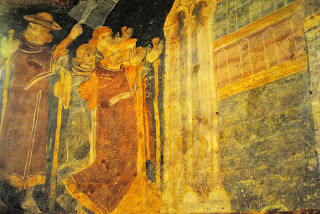
Not understanding more than the basics, I amused myself by wandering off a few feet like a dog on an invisible leash, poking my head into shadowy corners, past pale frescoes into barrel vaulted chapels, using my photocopied sheet as a guide while taking pictures.
I paid more attention when we went a few steps lower into a sort of crypt within a crypt – the St. Lubin Chapel – built after the Vikings destroyed an even older church in 858.
It felt like the bowels of the cathedral, with layers of history exposed.
Part of the ground is 4th century. Bits of masonry are Roman. Behind me, five niches set into a semi-circular wall might have originally been windows, but no one is sure. Near a massive round column, a jagged entryway ripped out of the wall by a 20th century archaeologist revealed an abandoned Carolingian passageway.
Moving away from the others I stood next to a ledge and breathed it all in, the still heavy air, the centuries of devotion. I could feel something powerful!
Back in the main part of the crypt we stopped at an ancient Druid well, nearly as deep as the cathedral is high, and where the Vikings tossed various martyrs. While many in the group launched into a spirited discussion, I strolled off with the vague intention of retracing the passage of the Middle Age pilgrims who would come to pray at a famous relic, the veil of the Virgin.
According to my info sheet, it was a very structured procession. The pilgrims entered the crypt from a north entrance along a very long gallery and circulated south from darkness to light. As I was starting out from the wrong end, moving from the light into darkness, it was very hard to see. I ended my walk at the sacred veil and put my head next to it where I felt God’s energy sweep through me. I also stood at the ancient well and connected with the energy emitting from the earth below. It is hard to describe what I experienced but I truly crossed a portal into the Sacred. I sing the words of the Song of Mary as I depart:
My soul magnifies the Lord
And my spirit rejoices in God my Savior;
Because he has regarded the lowliness of his handmaid;
For behold, henceforth all generations shall call me blessed;
Because he who is mighty has done great things for me,
and holy is his name;
And his mercy is from generation to generation
on those who fear him.
He has shown might with his arm,
He has scattered the proud in the conceit of their heart.
He has put down the mighty from their thrones,
and has exalted the lowly.
He has filled the hungry with good things,
and the rich he has sent away empty.
He has given help to Israel, his servant, mindful of his mercy
Even as he spoke to our fathers, to Abraham and to his posterity forever.
So a group of us decided to take the tour offered from a shop next to the cathedral to explore the crypt of the church. Unfortunately for us, the tour was only in French but along with our ticket we’d been given an info sheet in English.
Our guide led us to a locked staircase and we descended into the largest crypt in France. Predating the cathedral, its foundations are mainly Romanesque but its roots go back further. Before the first church was erected in the 4th century, it was a Druid site, believed to be a place of sacred energy.
Only parts of the crypt were lit. As we shuffled along down a gallery, our guide flicked lights on and off, stopping at points of interest. Whatever he was saying must have been entertaining because many were nodding and listening intently.
Not understanding more than the basics, I amused myself by wandering off a few feet like a dog on an invisible leash, poking my head into shadowy corners, past pale frescoes into barrel vaulted chapels, using my photocopied sheet as a guide while taking pictures.
I paid more attention when we went a few steps lower into a sort of crypt within a crypt – the St. Lubin Chapel – built after the Vikings destroyed an even older church in 858.
It felt like the bowels of the cathedral, with layers of history exposed.
Part of the ground is 4th century. Bits of masonry are Roman. Behind me, five niches set into a semi-circular wall might have originally been windows, but no one is sure. Near a massive round column, a jagged entryway ripped out of the wall by a 20th century archaeologist revealed an abandoned Carolingian passageway.
Moving away from the others I stood next to a ledge and breathed it all in, the still heavy air, the centuries of devotion. I could feel something powerful!
Back in the main part of the crypt we stopped at an ancient Druid well, nearly as deep as the cathedral is high, and where the Vikings tossed various martyrs. While many in the group launched into a spirited discussion, I strolled off with the vague intention of retracing the passage of the Middle Age pilgrims who would come to pray at a famous relic, the veil of the Virgin.
According to my info sheet, it was a very structured procession. The pilgrims entered the crypt from a north entrance along a very long gallery and circulated south from darkness to light. As I was starting out from the wrong end, moving from the light into darkness, it was very hard to see. I ended my walk at the sacred veil and put my head next to it where I felt God’s energy sweep through me. I also stood at the ancient well and connected with the energy emitting from the earth below. It is hard to describe what I experienced but I truly crossed a portal into the Sacred. I sing the words of the Song of Mary as I depart:
My soul magnifies the Lord
And my spirit rejoices in God my Savior;
Because he has regarded the lowliness of his handmaid;
For behold, henceforth all generations shall call me blessed;
Because he who is mighty has done great things for me,
and holy is his name;
And his mercy is from generation to generation
on those who fear him.
He has shown might with his arm,
He has scattered the proud in the conceit of their heart.
He has put down the mighty from their thrones,
and has exalted the lowly.
He has filled the hungry with good things,
and the rich he has sent away empty.
He has given help to Israel, his servant, mindful of his mercy
Even as he spoke to our fathers, to Abraham and to his posterity forever.